Sunday, July 24, 2011

Safe Sex

Last Wednesday I got to watch one of my girls giggle her way through putting a condom on a wooden model of a penis. It was, without a doubt, a productive day.

Talking about sex in Chile is a delicate endeavor. Although most soap operas here border on soft porn and mainstream culture is over-sexualized to the max, Chile is also an extremely Catholic country. Hogar San Francisco, where I volunteer, is a Catholic institution and the nuns wandering through the patio are a constant reminder of what we're allowed and not allowed to talk to the girls about. Volunteers spoke to the staff about creating some sort of Sex Ed workshop in the past but met resistance. For some reason, though, possibly including the fact that one of the girls recently moved to a home especially for pregnant teens, the staff was more open to the idea when Jamie, my co-volunteer, and I brought it up two weeks ago.

We recently discovered a clinic here in Santiago called ICMER (Instituto Chileno de Medicina Reproductiva, or Chilean Institute of Reproductive Medicine) that's quite similar to Planned Parenthood. By local standards, ICMER is a very liberal clinic, mainly because they provide emergency contraception, no questions asked. Normal pharmacies here carry the morning-after pill but often refuse it to customers or provide it with a side of judgment. ICMER also offers a free family planning workshop every Wednesday that goes over every birth control option clearly and thoroughly.

Jamie and I, with miraculous permission from San Fran, took the six oldest girls to this workshop last week. I expected the girls to collapse into piles of laughter with every diagram and mention of the word "penis," but they impressed me. They listened respectfully, asked thoughtful questions and, of course, let the occasional giggle slip out. Sandra, our bad-ass new midwife friend who runs the workshops, was great about helping them relax and ask questions, however basic. The girls took the workshop seriously and seemed to have a lot to think about when we left.

There was only one other person in the workshop with us, a teenage girl who had come with her mom, although her mom stayed in the waiting room during the workshop. The presence of this girl made me think a lot about everything our girls miss out on by not having supportive families. It's great that Jamie and I brought the girls to this workshop and we can follow up with them later on about these topics, but that's still light-years away from an ideal situation. Almost every girl we work with has been sexually abused--for many of them it's why they're in the home. We can tell them their options and laugh with them through a condom demonstration but we can't make sex be something normal for them, something that doesn't come with a lot of fear and confusion. It's confusing enough for kids who live with supportive families that communicate openly without adding a history of abuse into the mix. When I wish for safe sex for these girls, there's so much more to wish for than pills and implants and injections.

So we're just going to keep trucking! Everything we do with the girls is meant to help build their self-esteem and create positive self-images, so hopefully, although we'll never really know, one of these days one of the girls will make a decision that's good for her and not just what she thinks she should do. And, maybe, everyone once in a while we can remind that girl of how soft she said the lubricated condom made her hands feel. Bonus.

Sunday, July 10, 2011

A newbie after two and a half years

I distinctly remember the terror I felt the day I walked down Octava Avenida to Residencia Entre Todas for the first time back in December of 2008, totally unsure of what to expect from the group of 25 teenage girls just waiting to eat me alive. For the first few months I worked there, I felt a small percentage of that terror every time I rounded that corner. I was intimidated by the girls, constantly relied on my co-volunteer Chris to help me understand their Chilean Spanish, and struggled with feeling useless and unwanted. These struggles, of course, made the good days and even the smallest of breakthroughs an incredible reward and motivation to continue. When Entre Todas closed, I felt in part what someone might feel after a break-up or the death of a loved one: I didn't think I'd ever want to work with a different group of kids, both because it would be incredibly difficult to start the process of building those relationships over again, but also because how could any other girls be as bacán (Chilean slang for "cool") as my girls?

Time dissolved that feeling, of course, and I started thinking about which of the other VE partner institutions I might want to work in. Having had the opportunity to spend time at all of the institutions, I felt a bit guilty making the decision myself, choosing the group of children I preferred to work with. In the end, though, we made the decision as we would with any new volunteer, looking at both institutional needs and my skill set. Working for two years at Entre Todas made me a shoe-in for Hogar San Francisco de Régis, a home where 30 girls between the ages of 5 and 20 live and eat ice cream every day. Perfect.

It's now been about two months since I started work at San Francisco, which means I've spent eight eventful Wednesdays there. Not only does it feel important and exciting to be volunteering on a regular basis again, I'm already head over heels for the San Fran girls. There's a happier vibe overall at San Fran, and although the girls have all experienced extremely difficult circumstances in their lives, San Fran has many systems in place to make their lives as positive as possible. Like many residential homes in Chile, San Fran has both a full-time pyschologist and a full-time social worker. Among other staff members are a full-time teacher for the girls above age 11 and a part-time teacher for the girls under age 11. Study hour is actually a productive time at San Fran and it's clear to me that the girls are receiving significantly more support in this area that the girls did at Entre Todas. Another full-time staff member manages the girls' medical appointments and the girls all see a dentist regularly. There's even an aerobics/dance instructor who teaches an upbeat class twice a week for all the girls using the latest reggaeton hits to motivate them. And finally, as I mentioned, they eat ice cream virtually every day from a soft-serve machine donated by Leonardo Farkas, a well-known Chilean businessman and philanthropist. (He also donated two trampolines to the home but those have been long destroyed).

This doesn't mean that the girls behave perfectly by any means, in fact it's quite often the opposite. The difference with San Fran, though, is that I feel as though I have multiple people I could go to if I were really struggling with one of the girl's behavior. I've witnessed some of those difficult moments already, but my overwhelming initial feeling about San Fran is extremely positive. Perhaps I'm in the honeymoon phase of this particular brand of culture shock, but I think there's also something to be said for having operated in the VE community for so long. Not to toot the VE horn, but I feel as though I've picked up invaluable strategies and techniques for working with kids, helping kids with homework, and running a variety of workshops. Sitting down to help a girl with her homework feels like much less of a daunting task now than when I first arrived in Chile. Surprisingly, I haven't experienced much of that terror that was so prevalent for me at the beginning of my time at Entre Todas.

Above all, I'm having a lot of fun. I start each shift at San Fran by eating lunch with the staff members, who seem to truly make an effort to make the volunteers feel included. These lunches are sometimes serious and I get to hear the their thoughts on issues related to the girls and Chile's child protective services, etc.; sometimes, though, lunch is filled with gossip and off-color jokes as we serve ourselves second helpings of ice cream.

And last but not least, the girls themselves. At any given time, two of the little ones will be upside down, practicing their handstands against a wall, a table, or a near-by person. They're endlessly excitable and enthusiastic to join any workshop we introduce. The older girls hold the power in the home and have incredible influence on the younger girls. They have a clear sense of respect and justice and ensure that the younger girls respect us and the other staff members. Their love and care for the younger girls is also apparent and it seems that everyone at San Fran is invested in the well-being of everyone else.

I feel frustrated that I only see them once a week but I can tell I'm building bonds with some of the girls, slowly but surely. I had the opportunity last month to accompany a group of the girls along with Clem, another volunteer, to a heated indoor pool where Clem led us through a basic synchronized swimming lesson. On our way to the pool, I stopped for a snack because the evening snack at the home had been, of course, bread. Hand in hand with two of the girls, I explained to them about being Celiac and what that means. They seemed to feel suddenly responsible for my well-being and ushered me into a mini-market where they suggested a few snack options for me. "How about this yogurt, Tía?" one of them said. I told her it was a perfect idea and bought it. Continuing on our way, one of the girls took my hand again but then let it go and said, "You should eat your yogurt now, Tía, so it digests before we swim." She was clearly a little nervous about walking along the dark street without holding anyone's hand but wanted to show how polite she could be. "Take your time," she added, looking up at me with her killer smile.

In the two years and eight months I've been in Chile, I've gone through a number of phases, some more productive than others. I've lived in four different apartments, have run orientations for nine groups of new volunteers, and have experienced countless personal shifts and developments. Starting work with the girls at San Fran has reminded of why I came to Chile in the first place and has given me a chance to acknowledge the progress I've made, along with the goals I'm still working towards. It's easy to get caught up in the day-to-day here, but as a particularly wise 19 year-old volunteer reminded me recently, it's not about us, it's about them, the kids. Of course everything we do at VE is about the kids, but after six months without consistent direct contact at any of our institutions, I feel as though I've injected authenticity back into my experience. It's good to be a newbie!

Wednesday, May 4, 2011

Myrtle Beach, 2007

(To Kate on her 26th birthday!)


“‘Who’s that?’ will be the caption for that one!” the man sitting at the table with his wife calls to the woman taking a picture. She’s pointing the camera at her husband who’s lying on a chaise lounge with his white terry-cloth beach hat over his face, belly pushing toward the sky.
“We don’t look like we used to in bathing suits,” she replies to the other couple as her husband pulls the hat halfway off his face and peers out to see who she’s talking to. “That’s life, I suppose,” she says and hands the camera to her husband who has a holster for it on his belt. “Do you have the key?” she asks.
“No, I thought you did.”
The woman throws her hands into the air. “I told you to get it,” she says. “I told you to put it in your pocket.”
The husband reaches into his pocket and finds the key. He doesn’t look surprised. He turns the camera back on and lifts it to photograph his wife. She stops her fussing and poses, asking, “Did it take?”
They leave the lounge area and the other couple stays at the table for another hour, not saying a word to each other, just looking around.

~~~

It’s March in Myrtle Beach, and although my friend Kate and I are here on Spring Break, we’ve seen more people over sixty than of our own age. When we swim in the pool, a few loose-skinned women in flowered bathing suits watch us, looking up from their paperbacks when we laugh particularly loudly. When we lie on the blue and white striped lounges, we’re occasionally gazed upon by couples with wrap-around sunglasses, the men’s caps balanced precariously on the tops of their heads. Even in the coffee shop where we check our email, men in their fifties and sixties huddle over laptops.

What baffles me at first is their contentment with just sitting. When two couples sit together under one of the umbrellas, they chat, but when it’s just a husband and wife, they barely speak. Have they run out of things to say to each other?
Kate and I, of course, are just like them. Though I’d like to think we always have hip, intelligent things to talk about, sometimes we just sit in the sun, enjoying one another’s company and wondering how our tans are coming along. I decide that I’m relieved we’re sharing the beach with these folks and not other people our age on “Spring Break AWOOHOO!”

~~~

“What I would do differently next time is add a layer of swiss cheese,” the woman in a strapless, skirted bathing suit and bright pink lipstick says. “It was delicious, but I would add a layer of swiss cheese. I would put the cheese, then the sauerkraut, then another layer of swiss cheese.”
The women on the lounge chairs around her nod, not even trying to get a word in. They’ve laid their beach towels on the chairs and rest with their legs stretched out in front of them, likely reveling in a brief break from their husbands.
“You know,” the woman says a little later. “Every morning I wake up and feel so blessed. I’m sixty-eight years old and I’m just so lucky to be able to come here every year. We come for three months every year. This is the best deal we’ve found. You won’t find this kind of a bargain down the street. I don’t need frills, I just want clean sheets and friends. So we come here.”
A few chairs over, Kate and I lay with our beach towels under us. A plane pulling an advertisement flies over the water in front of us.
“Domino’s,” I say. Kate groans.
Ten minutes later, the plane flies over again.
“Domino’s,” I say again. “Large two-topping pizza, $9.99.”
Kate digs into her beach bag for her phone. “We’d get it just in time for the 3:00 Full House,” she says.
I giggle as she leans back in her lounge chair and dials the number from the banner in the sky. We pack up our towels and arrive upstairs just in time to meet the delivery guy.

~~~

Kate and I aren’t discussing recipes yet but for some reason I see my future in the women at the beach and it puts me at ease. I can’t sit with just anyone, doing nothing, and feel completely content, so I take the opportunity to have a cheesy moment about this Kate of mine and acknowledge that I, too, feel lucky. Our hotel room came with a kitchen and a balcony, the guys at the dueling piano bar played our favorite Steely Dan song (“Peg,” obviously) and our biggest problem is that, as it turns out, getting into a hot tub with a sunburn is really, really painful.

Heading back to Baltimore in my ’94 Camry, we realize we’ve driven for an hour on the wrong road and feel, for the first time all week, a little grumpy. It’s not so bad, though, because we’ve got Fleetwood Mac on my iPod and we can go our own way and we’ve got a box of Reese’s Puffs and Puffs are flying everywhere and we’re Spring Breaking the Rules! (Not so much, though, because the speed limit down here is seventy miles per hour but we’re doing our best and I think we’re having a pretty awesome time.) In that moment I’m feeling confident I’ll still know Kate when we’re both wrinkly and worried about how many layers of swiss cheese is the right number of layers of swiss cheese and that’s a pretty okay thing to look forward to.

Sunday, May 1, 2011

Is this Yerba Loca?

Now that I've been in Chile for so long, it's tempting to spend my weekends drinking coffee and puttering lazily around Santiago, especially now that winter's on its way in. In this country, though, I have to remember that the rewards for getting out of the city are always incredible.

Last weekend I went with four friends to Yerba Loca, a nature reserve northeast of Santiago. It's accessed from the same road as the well-known ski areas outside Santiago but isn't famous enough (yet) itself to be in Chile guidebooks. In retrospect, a guidebook entry about Yerba Loca could have helped us, but being slightly underprepared allows for lots of after-the-fact giggles.

The theme of the trek, which from the parking lot to the campsite was about 18 kilometers, or 11 miles, became "Is this right?" There were moments of "Is this the path?" and "Is that where we have to go?" As the end of the hike became increasingly steep, bringing us to 3800 meters (12,500 feet) via a slippery, rocky, winding trail, I began to feel hopeless, stopping practically every 10 meters to give my heart a chance to slow down.

At the end of one particularly difficult hill, we reached an open area where a lone tent was pitched. "Is this the campsite?" we said. Thanks to the other hiker camping out, we learned that yes, it was, and we could finally take our packs off.

Here we are on a unique, forgivingly flat portion of the trail, gearing up to climb the mountain in the background:
Here's our incredible campsite, the most remote site I've ever experienced:
Our excitement at arriving at our resting place quickly faded as we noticed the cold. I can't say for sure what the temperature was that night, but I can say that I shivered the night away in multiple layers and a down sleeping bag supposedly good to 20 degrees Fahrenheit/-7 Celsius.

We had read that the water in the streams, although run-off from a glacier, was unsafe to drink due to a high content of minerals. The other camper at the site, though, told us that the snow was safe, so we collected it from along the stream and over the next couple of hours managed to heat enough water for tea and the most incredible lentils and white rice I've ever tasted.

The night was not the most enjoyable I've experienced. The tent we borrowed turned out to be a summer tent with lots of ventilation, which didn't work so well for a windy winter night. I was in better shape than my tentmates Faith and Lindsey, though, who survived the night snuggling between a comforter and a slumber party sleeping bag. One could say, though, that it's important to have these nights to appreciate a warm bed with an appropriately firm mattress.

In the morning, we were all too cold to sit around cooking breakfast, so we got up and immediately hiked the remaining 3 kilometers to the glacier (or what we're pretty sure was the glacier...). The sun was fully out by the time we got back to our campsite, so we enjoyed a leisurely breakfast before the 18 k return trip.

Here we are in front of the glacier, which the sun made difficult to photograph:
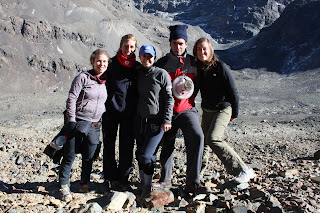
And a group shot: Faith, Meg, Lindsey, Nico and me!
The hike back down, although equally beautiful as the hike up, was a bit of a struggle as we were all pretty sore from the day before and didn't have any drinking water left. Much of the terrain was rocky, so the steady impact was rough on the joints, but we survived and made it to the parking lot, where the chlorinated Santiago water from a tap was the best thing I'd tasted in ages.

It took about three days for me to be able to walk normally again, but all the better to have a reminder of how great it feels to push myself and take advantage of what Chile has to offer besides a great café cortado.

Tuesday, April 19, 2011

Santiago Half-Marathon!

I'm happy to report that on April 3, I completed the Santiago Half-Marathon! I wrote a blog post about the experience for VE Global's website, so please take a look here!

Sunday, April 17, 2011

The End of Entre Todas

Last December, the home in Santiago where I volunteered for two years called Entre Todas was forced to close down due to major funding cuts. The months leading up to the closing were difficult ones, the girls acting out more than usual, reminding me that children aren't built for such instability. Talking to a fifteen-year-old girl about not knowing where she was going to live, if it was going to be another group home or her own, chaotic, unsafe home, was a frighteningly hopeless experience. I felt worried for the girls who had lived at Entre Todas for seven or eight years together and were, for all intents and purposes, sisters. I felt worried for the girls whose cases were being expedited in a effort to get them back with their families instead of finding spots for them at other group homes. I felt worried for the eight-year-old who, as she watched the other girls leave the home one-by-one, still didn't know where she was going to live with just two weeks until the closing date of the home.

The girls began leaving in October and I quickly learned that I had to adopt a rather zen attitude about the whole process. The first girl was moved to her new home with no warning, leaving the other girls in tears, angrily demanding that the staff give them warning and some sort of recognition of the occasion. When the next two girls left, the staff provided a goodbye party, complete with balloons and Cheetos. Unfortunately, that type of celebration happened just that one time and it became the norm for me to arrive for my weekly shift at the home to find that someone else had been moved. I had to tell myself that the time I had spent with each girl was more important than saying good-bye. At a certain point I started to feel more removed from the process than anything else, knowing there wasn't anything I could do to change what was happening. As a co-volunteer and social worker reminded me, some of the girls were potentially getting the chance to move to a place with better care and attention. Although it had its bright moments, Entre Todas was never the best place for any of them.

The Entre Todas staff held a sweet good-bye party for the home itself, with dancing by some of the girls, slideshows of photos, homemade empanadas and speeches by staff members and a lot of the girls. Despite the leaky roof, the monotonous food and general chaos of the home, the girls had beautiful things to say about their time there. Although it may not always have been obvious, there was a lot of love and care there.

A few weeks ago, I went with Vicky, another former Entre Todas volunteer, to La Pintana, a municipality in the south of the city where ten of the girls live in two homes that are just around the corner from each other. It was the first time I had seen any of them since December, so it was incredible to see that they were doing well and that the homes they're living in seem, indeed, much nicer than Entre Todas. The girls we saw seemed happy for the most part and content to be where they are, which reminds me of their incredible resiliency and ability to adapt despite extremely shitty situations.

The younger girls we visited immediately asked when we'd be coming back to visit again, which made me think a lot about how to best support them without making promises I can't keep. Vicky and I will try to make visiting a semi-regular occasion, but with the three-hour round-trip journey and everything else we have going on, it's not something we can commit to doing every week.

A couple of the girls, including one of the girls I was closest with, weren't home when Vicky and I visited, which was frustrating as La Pintana isn't exactly around the block from the city center where I live and work. Last Tuesday, though, after visiting one of VE's partner institutions in Puente Alto, a municipality to the east of La Pintana, I heard someone yelling "Tía Mariah!" from across the street as I was walking to the Metro. I turned and saw the girl I had been so bummed to not see on our visit waving to me. I screamed and made a terrible scene as she crossed the street, an endearing self-conscious smile on her face. As it turns out, she goes to school very close to the home I had been visiting and, on this day, had forty minutes before her first class. We bought a soda and a snack and plopped on a bench, me bombarding her with questions about her new home and school, etc. She was quiet, as she always is, but answered my questions eagerly, smiling the whole time. She seemed happy and calm, is excited that her older sister is having a baby in a couple of months and that she herself is going to start studying nutrition and cooking next year. It eased my mind to hear her news and know that she has settled into her new routine and is getting good grades, etc.

Seeing some of the girls, though, has made me think a lot about the girls who went home to their families and how I have no way of contacting them to see how they're doing. I've heard through various sources that some of the girls are in pretty difficult situations at the moment. Even though I know logically that by continuing my work at VE, I'm contributing to the support of hundreds of kids, it's hard to think that girls that I knew for a long time are here in Santiago but no longer in a place where they can benefit from VE volunteers. I asked the girl I bumped into if there were any activities or volunteers at her new home and she shook her head, saying, "It's not like it was before."

I know that VE can't work with every child in Santiago--this is the nature of service work, there's always more need somewhere. I also know that sometimes it's impossible to separate this type of work from the emotional attachment it creates. I feel lucky to have known the girls at Entre Todas and to have memories of certain days there that still make me laugh out loud. I'm still struggling to find a balance between letting go and figuring out what more I could do for them in a sustainable way. There's no easy answer but I suppose that's just good practice for life in general and the decisions we all have to make at various difficult moments along the way. For now, I can try to find time every month or so to take a ride on the 205 down to La Pintana.

If you're interested in reading more, my co-volunteer, Alex, wrote a beautiful blog about the closing of Entre Todas for VE's website, which you can access here.

Sunday, February 13, 2011

Running for VE

In the past few months, I've somehow suddenly become quite interested in running. After so many years of tights and leotards, I sometimes laugh at the sight of myself in running shorts and sneakers, but so it goes, things change. I've dabbled in running for years, but for some reason I've been able to run longer distances and even enjoy the experience lately, which never happened before.

And, as it turns out, running is more fun with friends and concrete goals! In October I accompanied Josh, VE's Executive Director, and a few other VE-ers to run in Concepción, the city in Chile most affected by the February 2010 earthquake. Josh and a friend of his were raising money for VE and the American Red Cross and pledged that if they made a certain amount of money, they'd run the half-marathon. And run it they did! I ran the 10 k, but even as we picked up our numbers the day before the race, I had an itch to run a half. A few months later I ran another 10 k in Santiago, again with a group of other VE volunteers.

And now I'm training for my own half-marathon! I'll be running on April 3rd in my dear Santiago. I'm looking to raise $500 for VE with this run, so if you have an extra $5 floating around someone, I have a great place for you to put it! With the help of Matt Suggett, a computer wiz and former VE director who's training for the Madrid marathon to raise money for VE, I have this sweet donation page that makes donating to VE a cinch. Check it out! There's even a cool little feature on there that makes it possible to track my training through dailymile. Any support would be greatly appreciated! I've already been blown away by the support I've recieved, but I still have a little over $200 to go!

I'll leave off with a couple of visuals of the camaraderie I've so loved:

In Concepción with Meg, Josh, Marco and Meghan
In Santiago with Marco, Lindsey, Nico, Meg, Josh, Annie, Faith, and Stephen

Blog much?

Soooo July 25th was my last blog. Yimes. I think, though, that this lapse in time is a sign of a significant and positive shift in my experience here in Chile. (Yes, I'm still in Chile!). Back in June and July I stopped feeling as though I were having an abroad experience and started feeling as though I were living my life, Santiago style. Moving out of the VE bubble and buying a bicycle really sealed the deal. One day as I was biking to my then-new apartment, I realized the amount of control I have over my own experience and decision-making process. I could bike on the wrong side of the river if I wanted, not caring if it took me longer to get home. I could stay in Chile longer, embracing the fact that life here is indeed reality and a happier reality than I've had anywhere else.

So that's what I've decided to do! I got a little promotion at VE to Director of Operations and in December signed on for another year. It was an easy decision. Student loans be damned, I'll figure something out.

As Director of Operations, my job includes a lot of what I did as Director of Volunteer Relations in terms of running our volunteer orientation program but also includes institutional relations, aka maintaining VE's relationships with the community centers, homes, and schools we work with. The new aspects of my job are quite scary to me but that's why I like them. Each call to the ever-intimidating Señora Ana, director of one of our girls' homes, feels like a small victory, for example. Plus I still get to work closely with all of our amazing volunteers, which is what keeps us inspired.

Last week I went with Josh, VE's Executive Director since June of last year, to visit Centro Comunitario Los Navíos to be interviewed by the three children participating in a journalism workshop with two of our volunteers. The kids each sat up straight at the table, nervously fiddling with their notebooks as they asked us questions from their thoroughly prepared lists. These kids live in one of the most at-risk areas of Santiago but had put on their best sweaters and flat-out dumbfounded me with their thought-provoking questions and insights about our answers. They were the definition of politeness and graciousness. I left feeling more convinced about the importance of our work than ever.

No life, however glorious, is without its ups and downs, but despite those downs, I feel grateful that this one is mine. Getting to help keep VE sustainable is most definitely a mutually beneficial relationship. I've even found a bakery that makes amazing gluten-free bread. It's neither cheap nor close to my house, but hey, it's progress.

Sunday, July 25, 2010

Gut Instincts and Toddler Spittle

I’ve recently begun making visits to the various institutions VE partners with to see how each of the volunteers is doing in his or her work environment. I began making the visits for a number of reasons, mainly to increase my support of the volunteers and to begin to more fully understand the experience of volunteering at the different institutions. Although I know very well the experience of working with the adolescent girls at Entre Todas, I previously had no real sense for the nature of the work at our other partner institutions.

So far, the visits have been even more successful than I anticipated. Even riding the Metro to the institutions with the volunteers has proved to be a great opportunity to chat about how work and life in general is going. I see some of the volunteers more than others, so this is a great way for me to get one-on-one time with everyone. In the past, some volunteers have only come to me if they’ve been having a problem, so this gives me a chance to catch up with them about the positive aspects of their lives in Santiago, too.

Now, whether this fits into my previous description of the visits as “successful” or not, I’ve been loudly reminded of the various delightful facets of working with small children. Last week I visited Hogar Esperanza, a home where the majority of the children are babies and toddlers. Within five minutes of my visit, a two or three-year-old girl noticed that the she and I had ended up in one of the playrooms alone, so she announced that she was going to leave me alone in the room and that I was going to cry. She then proceeded to leave, slamming the door behind her. She later hawked a lougie onto the back of my head and would have delivered another to my face had I not ducked. I was forced to remind myself of the advice I always give incoming volunteers: the kids will do things that seem like a personal attack but the motive comes from an entirely different place.

On my visit to Hogar Pléyades, where the children are between the ages of two and ten, I experienced a similar discovery of the ever-fluctuating attitudes of young children. Their behavior is simply an extremely honest reflection of their emotions at each and every moment. Painfully obvious, yes, but interesting to me as I’ve been chatting with a friend recently about our instincts as adults to feel guilty or unreasonable for reacting in a “childish” way to something sad or frustrating. Children haven’t yet learned the manner in which adults feel they should react to any given situation and therefore react to the events in their lives more authentically.

The honesty goes beyond emotions, as well. I spent twenty minutes with one of the six-year-old girls at Pléyades on the patio, helping her hobble around on her rollerblades. I was having a great time until she randomly stopped, put a wrinkly nosed smile on her face and said, “Tía, you don’t have any boobs, you’re a MAN!” She then laughed maniacally for a moment before she reached her hands back out and said impatiently, “Let’s go.”

Clearly I don’t think adults should go around saying things like that to each other, but I’ve definitely left these recent visits with thoughts about honesty and authenticity. With my departure from Chile in the ever-approaching future, I’ve been thinking a lot about what sorts of decisions I should make in the coming months. I’m feeling more content than ever right now, in huge part thanks to a beautiful new living situation. I feel more balanced and able to listen to my instincts now, even if the decisions they lead me to make take some courage. I’ve found that this only makes the results more rewarding. (Feel free to groan or roll your eyes here).

As for that ever-approaching future I mentioned, it looks like I’m going to be staying with VE through early December or so. Although any VE-er will tell you that I’m actually never leaving, I want to make sure I never arrive at a time in which I’m not feeling excited about the work. I want the person in my position to be energetic and fresh, so I'll just need to keep listening to my instincts about whether or not that person is me. For now, I'm still very, very happy to be where I am.

Friday, July 2, 2010

Caring about the World Cup

I'm a bit baffled that I've just sat down to write a post about sports.

All bafflement aside, I must proceed and admit that I'm really into the World Cup this year. Now, "into" should be taken fairly loosely considering the number of Chileans who actually purchased flat screen TVs for the occasion and the fact that I didn't know until three weeks ago that soccer had rules beyond "Try to get the ball into your opponent's net."

Chile hadn't qualified for the World Cup since 1998, so when they beat Colombia to qualify, the celebrations in Plaza Italia looked like this:

I think I can safely say that every single person in Chile who's old enough to form opinions and young enough to remember their own name cares deeply about soccer, or here, fútbol. One of my first memories from Chile is looking out the kitchen window of my first apartment to Parque Bustamante, where a dad was holding his unsteady toddler's hands to help him walk, a miniature soccer ball bumping along in front of the boy's feet. I can't think of anything quite so universal in the United States, and I've certainly never seen fans in the US act like the fans in Chile.

As the World Cup began, there was an excitement in the air as if Christmas were around the corner. On the days when Chile played, schools opened late to allow everyone to watch the games. People selling fruit on the streets suddenly had TVs tuned to the game at their stands. In bars and restaurants, it was wise to order everything you wanted before the games started, as the waiters and cooks would file into the dining areas to watch, becoming increasingly more difficult to waive down as the intensity of play increased. In the VE office, we'd huddle around the TV in the living room, laptops on our laps just for show.

I've learned a lot in the past few weeks about the surprisingly complicated game of fútbol. I certainly couldn't explain the off-sides rule to anyone, but at least I now understand what's happening when the referee flashes those little yellow and red cards. On the down side, I don't think I'm anyone's favorite person to watch fútbol with. Although I've gotten better at recognizing good plays and bad plays, I'm normally more interested in making commentary that involves the players' facial hair. There are also a few traditions I can't seem to move past. For example, at the end of every game, the players exchange jerseys, sometimes putting them on right then! Jerseys that have been aggressively sweat into for the past ninety minutes by someone else, and the players just pull them right on. Sick.

Watching the Chile World Cup games here in Santiago was certainly a treat. Whenever Chile scored a goal, we'd open the office windows and listen to the immediate explosion of screams and honking horns. When they won their first two games, the celebrations that followed were on par with the best I ever watched from my old apartment on the 15th floor. As usual, the police started with water cannons, then brought out the tear gas. After one of the games, we watched from the office as the police cavalry chased some fans down the side street outside our windows. Even after Chile lost to Spain but moved on the the next round, the mass of people in Plaza Italia was as giant as ever. Even Telefónica showed its Chilean pride with a huge flag on its building in Plaza Italia:

On the one hand, it's great to see so many people fired up about one thing, celebrating together in such a no holds barred way. On the other hand, I wonder how they don't get sick of the same routine every time. Perhaps that's the difference between me and a true fútbol fan. Although I might tire of jumping around with thousands of other people a few times a month, knowing I'd be blasted with water and tear gas and potentially chased by horses, the Chilean fans can't seem to stop themselves from celebrating, no matter the consequences. I guess that's passion for you.

Now that Chile's out of the running, I'm less inclined to check FIFA's website, but it's certainly been an interesting foray into the world of international soccer. At the very least, it's been a reminder to keep an open mind about what I might or might not find interesting. And at the very most, it's been great fun to experience the festivities with my VE colleagues. As for office productivity? Better luck next month.

Saturday, June 26, 2010

Bolivia!

Sometimes working a full-time, almost un-paid job in South America can be frustrating in that some of the most amazing travel opportunities in the world are right in my back yard, but I'm too much of a broke volunteer to get to experience them. Sometimes I decide to borrow money and go experience them anyway!

At the end of May, seven of us from VE traveled up north to San Pedro, Chile, a town alongside the Atacama Desert, then continued on to take a Jeep tour that would finish in the world's largest (4,086 square miles) salt flat in Uyuni, Bolivia. I flew up to San Pedro with my friends Annie and Ashton, where we met up with the other four of the group who had opted for the cheaper 24-hour bus. Although the Jeep tour was our "final destination," we took our first day in San Pedro to explore the famous Valle de la Luna (Moon Valley) in the Atacama Desert. Here are Annie and Ashton and I at the first stop of the tour in the tour of the Desert:
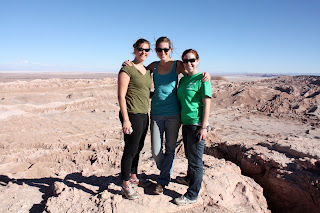

The tour took us to various famous locations in the desert and concluded with watching the sunset over the Moon Valley. At this point we met up with the other half of our group, then watched as the sunset reflected an incredible set of colors on the mountains surrounding the valley.

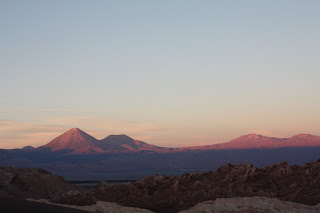
The next day we were off on the tour, which brought us immediately to the Bolivian border and 4800 meters (15,748 feet!), so it was coooold. Here's the Bolivian Migration building in the middle of the desert:

After some questionable interchanges in the migration building, we piled into our Jeeps and were off! Because we were a group of seven, and only six could fit into a Jeep, we had to separate into two vehicles, but met a cool couple from Scotland and one from Germany as a result. The first day we drove until about 2:00 in the afternoon when we arrived at the first refugio, which was an unheated, very simple building with beds and a large room with tables for eating meals. This location was at 4370 meters (or 14,337 feet), so the drivers told us to rest up to avoid getting headaches, etc, from the altitude. On the drive to the refugio, we stopped at incredible place after incredible place. There were a few lakes with distinctively colored water, geysers, and this hotsprings:
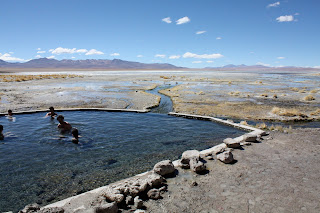

At the refugio, we ignored the advice of the drivers and went exploring. Although most of us felt fine aside from minor headaches, we found walking up even the smallest of hills extremely difficult. The place was too incredible not to explore, though--it was one of those places with huge sky and landscape like nothing I've ever seen before. When the sun set, I realized I hadn't ever seen a 360 degree sunset. It wasn't too bad.
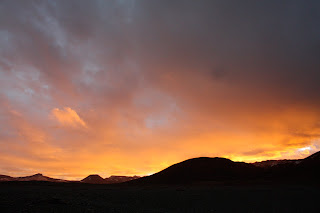

That night, though, was one of the only nights in my life I've ever had trouble sleeping because of the cold. In long johns, sweats, my L.L. Bean down sleeping bag, and the bedding on the bed, I was still freezing. With my face outside my sleeping bag I seriously feared for frostbite. With my face inside my sleeping bag, at an altitude with so little oxygen, I just couldn't breath. I was glad for the early morning wake-up call just for the excuse to get into the heated Jeep.

The second day of the tour brought more and more incredible sites. It became comical, almost, each time Ruben, our driver, would stop and say "Foto, foto," with slightly less enthusiasm each time. We started off at Laguna Colorado (Colored Lake) where we saw lots of flamingos!
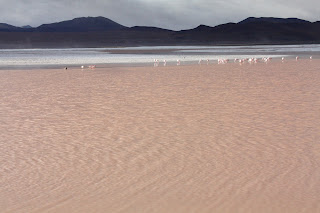
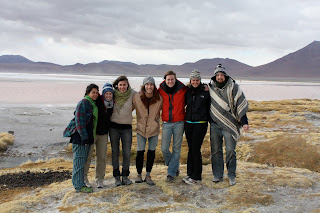
There were more incredible lakes, an oddly beautiful stone tree, a volcano, and non-stop photogenic scenery. For the second night of lodging, as we neared the salt flat, we stayed in a hostel made almost completely of salt. The picture below is of the dining area--all the tables and stools are made of salt, along with the walls. It was salty (I licked it).

The next morning we drove to the salt flat. On our way in, while trying to wrap our heads around what we were looking at, we drove past a man on a bicycle with a baby on the back. The surreality was thick. Here's a photo I snapped of the other Jeep while we were driving quite closely to each other on the salt flat:

The classic tourist activity on the salt flats is to take goofy pictures because something about the seemingly endless salt makes playing with perspective extremely easy. We took lots of pictures such as this one:

The tour also stopped by the first ever salt hotel, outside of which were these piles of salt:
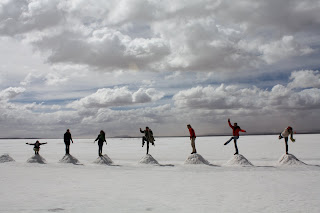
The Jeep tour ended at Uyuni's one other attraction: a train cemetery. After three days of unbelievable natural sites, ending at the resting place of a bunch of antique trains seemed strange, but interesting nonetheless. The trains were used mostly by the mining industry, apparently, but when the industry collapsed in the 1940's, the trains became obsoletes. For us, exhausted at the end of three long days of riding in Jeeps, the trains were simply a cool place to climb around for a minute before we moved on.
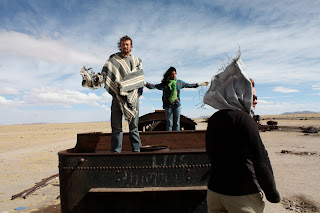
After the tour ended, our group went separate ways. Annie, Ashton, Madinah, and I continued on into Bolivia for a few days. After discovering that juice-in-a-bag was the best thing Uyuni had to offer beyond the salt flat and the train cemetery, we decided to take the next bus to Sucre, a beautiful introduction to Bolivian cities. Sucre has, in my opinion, an excellent balance of beauty and grit. The main square, pictured below, is charming, filled with manicured gardens and surrounded by gorgeous buildings.
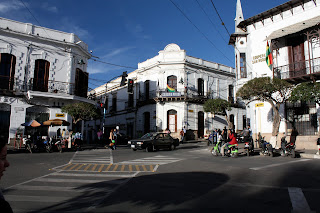
There seemed to be a fair amount of tourism, but there were also plenty of opportunities to see the vast differences between Bolivia and Chile. Living in Santiago, I sometimes forget what South America is really like. With it's big business and Wi-fi everywhere you go, Santiago is very much a modern, developed city. Sucre, although a beautiful city with everything you could need, was a reminder of a different way of life. A large percentage of the Bolivian women we saw, for example, wore traditional dress. Street stalls such as the one pictured below were much more common than grocery stores and seemed to be the way most people purchased all of their goods. It was difficult to find a soda or bottle of water that was refrigerated, but very easy to purchase fresh, unpackaged foods on the street. We were there on Bolivian mother's day and on the night before, it seemed that one in every twenty people was carrying an uncovered cake amidst the crowded streets.

On our last full day in Sucre, we took a half-day hike along a portion of the Inca Trail. The four of us had a private tour with a Bolivian guide who, along with being fascinated by his first all-female tour group, told us lots of interesting information about Bolivian culture and history. Bolivia's current president, Evo Morales, has declared himself to be the first indigenous president, for example. He's also apparently known for the striped sweater he always wears, which has become a popular style in Bolivia since he took office.

The trail itself, which dates back to pre-Columbian times, was incredibly beautiful. The colors of the landscape were unlike colors I've seen elsewhere--the greens were almost muted, the dirt and clay orange-y and purple in places. Along some parts of the trail we walked on new paths but in some places we walked on the original stones that has been placed there thousands of years before. Here's a photo that shows a new dirt road which we later drove up to get a view of the valley, which includes a massive crater in which you can see original dinosaur prints. Nutty!
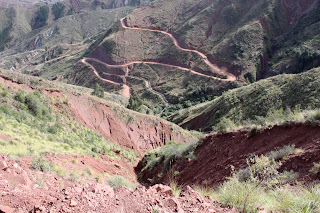
For the last two days of my trip, I travelled alone. Madinah headed further north to La Paz, while Ashton and Annie headed to another Bolivian city, Potosí, where they took a tour of a grim operating silver mine. Because of limited time, I needed to head back down to San Pedro to catch my flight back to Santiago. Transportation in Bolivia is much less efficient that in Chile, we learned, so I wanted to leave myself plenty of time. Although I was initially a bit overwhelmed at the prospect of traveling by myself, even just for two days, I found it quite relaxing and got a lot of reading and writing done, which was lovely.

Bolivia was a fascinating place and definitely one that I'd like to revisit. Perhaps I'll WWOOF there, who knows! Regardless, the trip was well worth going a bit further into debt for.

Sunday, June 20, 2010

Smog Season/Fresh Starts

Winter has most definitely arrived in Santiago. As I write this I’m perfecting the art of typing with my sweet new alpaca fingerless gloves with mitten flaps from Bolivia! Fun, perhaps, but necessary more than anything else. I’m also writing this on a Saturday night, which normally wouldn’t happen, but I’m sitting home with what was a flu but morphed into a sinus infection with a bonus side of pink eye! Thanks, Santiago, your smog has done me well, yet again.

There is also positive news to report, however! We’ve just finished the orientation program for the June class of VE volunteers, a class of ten, none of whom were welcomed to Chile by an 8.8 earthquake. Orientation went smoothly and we’re all quite enamored with this set of newbies. Anther exciting newbie at VE is Josh Pilz, who will take over for Brooke as Executive Director. We LOVE him. As sad as it is to see Brooke go, we’re all thrilled that Josh is the replacement! I first met Josh on our earthquake relief trip to Retiro and was thoroughly impressed with him as a human being. He has started his training in the VE office, even taking part in the majority of the June class’s orientation week. He’s even excited about Vanessa and Edmondstone, the tiny little VE turtles he’ll inherit as ED.

A very exciting detail that deserves its own paragraph is that one of the newbies doesn’t eat gluten. !!! I’ve already taken her to one of my favorite restaurants, fed her my from-scratch gluten-free pizza, and generally overwhelmed her with my excitement about having another of my kind around VE. She has stated repeatedly her gratitude that I laid down all the groundwork in training the VE staff on the art of gluten-free cooking, which is valid considering I ate lettuce and rice with tomato paste sauce during my orientation week.

In other new news, I’ve moved! We decided it was time to move on from cozy apartment 1505 (one cushy block from the VE office) and venture into the world of living with Chileans. I’ve found myself a perfect little quirky apartment three metro stops from the office in the very happening area of Providecia. I live with Jose and Max, two wonderful/terribly cool Chileans who are both in film. (I know). The apartment is great fun—the two boys live upstairs and downstairs are the kitchen, living room/dining room, and my room, complete with my own bathroom. The rent is cheaper than 1505, and I get to speak Spanish every day. I moved the Monday of orientation week, so was literally in the apartment only to sleep for the rest of the week, but now that life is returning to normal, I think I’m on my way to figuring out the rhythm of the casa.

And, because apparently I forget to tell people, I’m staying a bit longer than planned here in Chile! I guess I meant to leave some time this month, but for many reasons, including that there’s no one to take over my job yet, I’m staying a few extra months. My priority is to do what I can to help the transition for whoever takes my job go smoothly, and since the huge transition from one Executive Director to the next is currently happening, I want to be around and help in any way I can with that as well. The plan as of right now is to find someone for my job sometime in July, train them for the month of August, help them with the orientation for the September class, then head off to a farm to WWOOF for a few months. WWOOF-ing is something I’ve always wanted to do, and something I would love to do in Chile or Argentina or Bolivia, so this seems like the time. If all goes according to plan, I’ll be home for Christmas and a great big reality check!

All in all life is going wonderfully, as usual! There’s never a dull moment with VE and rarely a free one (it took me staying home sick to blog, apparently), so time continues to pass at an alarmingly quick rate. There have been a few tough good-byes recently with long-term volunteers moving on, but this new class of volunteers has given me very high hopes for the next three months.

Construction Trip to Pencahue, Chile

After such a fulfilling trip to Retiro to help with post-earthquake reconstruction, four of us decided to repeat the experience back in early May. We joined a group of students from the Universidad de Chile for a weekend of building in Pencahue, another tiny town about 5 hours south of Santiago. We brought our own hammers and measuring tapes on this trip and thank goodness we did, as not long after we pulled out of Santiago, the trip leader passed around a laptop with a spreadsheet into which each person was filling in their name, what tools they brought with them, and how much construction experience they had.

We thought nothing of the spreadsheet until the morning when, over clumpy powdered milk, we discovered that the group had been divided into teams of four people per mediagua (the pre-fabricated temporary housing we were there to build). There were 16 mediaguas sitting outside the school where we were sleeping and the plan was to finish them all by Sunday afternoon.

“That can’t be possible,” I said. “The guys in Retiro said 12 was the ideal number of people to build a mediagua.”

The 16 mediaguas in waiting

We were not in Retiro anymore! Still recovering from the 3:30 a.m. arrival in Pencahue and the 6:30 a.m. wake-up call, we all piled on to a bus that delivered us each to our worksites. Unlike in Retiro where the worksites were all within the “downtown” area of the town, we were each at least a mile from each other, most of us on family farms.

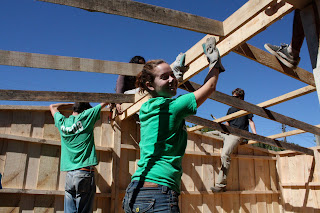
My team, luckily, was comprised of three Chilean students, each of whom had some significant construction experience. I was able to help a lot in the first phase—digging holes for the foundation pile-ons with iron rods! As we got into the more complicated building stages, I became an expert wall-holder and nail-hander-to-er. On Sunday evening as the sun set and the boys finished the roof, I was “in charge” of taking pictures.

Our team, plus a few members of the family, working on the foundation

The land around our site was absolutely beautiful, with mountains visible in the distance 360 degrees around us. As we worked, we were surrounded by cows, pigs, chickens, turkeys, cats, dogs, sheep and horses. At one point on Sunday morning, we saw the stream of run-off from the house flow red after the mother slaughtered one of the turkeys for lunch.

The best part, by far, of the weekend was getting to know the family for whom we were building the mediagua. Because all of us from the group were all so separated throughout Pencahue, we didn’t meet back up for lunch or breaks, we simply ate lunch with our families. When I told the family that I didn’t eat meat or gluten, I became an instant topic of conversation. I was presented with a beautiful bowl of lentils instead of the turkey soup everyone else was eating, and the mother cooked a batch of potatoes for me on the second day. Throughout the course of the weekend, each of the couple’s four daughters showed up, two with their children, so I got to explain my fascinating dietary requirements each time.

The welcome they extended was so warm, I didn’t notice until the end of lunch on Saturday the condition of the family’s house. It seemed to be combination house and grain barn, and I’m still not sure if they were only living there because their house collapsed in the earthquake or because they had been on the list for a mediagua and their time finally came. The house was put together with various materials, in some places just plastic sheets, and was thus incredibly drafty, so once the sun went down, they all huddled around a bowl of coals from the oven to keep warm. They were incredibly generous with us and incredibly appreciative, offering us hot coffee and tea and fresh homemade bread (an egg for me) each evening so we could take a break from the cold.

The father helping out with the foundation

The matriarch, looking adorable as usual

Handing up the zinc roof panels

In the end, our group of forty-eight people completed twelve mediaguas. A smaller group was planning on staying until Tuesday to finish the remaining four. Although I thoroughly enjoyed our trip to Retiro, I feel incredibly content to have gone on this trip, which felt infinitely more productive, and to have met that family. Hopefully they’re enjoying the new addition to their home!

With the family in the finished product!

Sunday, April 18, 2010

Earthquake Relief Trip to Retiro, Chile

Five minutes out of Retiro and the Chileans at the back of the bus had already cut open a melon, filled it with wine, and drawn a Jack-o-Lantern face in red Sharpie on one side. Eight hours later, we pulled into Santiago.

Since the February 27th earthquake in Chile, we at VE Global have struggled to find tangible ways to get involved and help the people in areas that were harder hit than Santiago. As I mentioned in my last post, we helped out briefly at the Red Cross warehouse, but wanted to make a more significant commitment of time and labor. After investigating several options, we were lucky enough to snag spots on a bus with a student organization from the Universidad de Chile to Retiro, Chile, a town of 3,000 people 335 kilometers south of Santiago. Seven of us from VE joined the huge group of students, fairly unclear about how the weekend would play out but hopeful that we'd be able to make some sort of concrete difference.

From start to finish, the trip was a delightfully Chilean affair. First, we left Santiago about an hour after the stated departure time. After arriving in Retiro and standing around for 30 minutes, we got word that there would be an organizational meeting at 6:30 and that we would be free until then. Happy with the opportunity to stretch our legs, we decided to take a walk around the town and take a look at the damage.

Seeing the state of Retiro reminded me of walking through the intensely poor neighborhoods of Guatemala City where I volunteered with Safe Passage--both situations were so extreme, I had a hard time wrapping my head around the fact that I was physically there, seeing the conditions in front of me, not in a newspaper or a movie. The damage is incredible, and I can only imagine what the town looked like a month ago before any debris clearing had been done. We described it to our friends back in Santiago as looking like a war zone, holes where buildings used to be everywhere you looked.

We were welcomed to Retiro by this house, which sits directly across the street from the old school building where we stayed. While our building had only cracks, this house was absolutely destroyed:
Walls such as this one fell all around the town and those left standing have "Peligro" (Danger) spray-painted on them.
The most incredible site was this fallen water tower, which had knocked a second water tower down as it fell. We kept trying to imagine what the sound of this cracking and smashing to the ground was like.
In addition to the damages we saw, we also saw a lot of evidence of the work that's already been done to begin rebuilding the town. Two of our friends who had taken a previous trip to Retiro two weeks earlier told us that this house had been destroyed when they saw it on their last visit but had been rebuilt in the past two weeks. The wooden portion of the house to the right had previously been made of adobe and had completely fallen but was rebuilt beautifully to look like this:
We also saw quite a few "mediaguas" already completed around the town. Mediaguas are pre-fabricated temporary shelters that are currently being built all around Chile. They're 6 meters long by 3 meters wide and are meant to temporarily house a family of four for approximately one year, though they're meant to last up to ten. It was clear to us, however, while walking around Retiro, that these mediaguas would be in no way temporary for most of the families living in them. With winter fast approaching, the mediaguas are clearly better than the tents many families are living in, but picturing a family crammed in the tiny space for years and years is a hard thought to sit with.

It didn't take long for us to meet the precocious children of the town, who were both adorable and thrilled to meet some gringos. It's much less common for people in a town such as Retiro to hear English, especially as compared to Santiago, so they begged us to speak to them in English, laughing hysterically at the sound of it. They were also eager to have their pictures taken and showed no shortage of sass:
Upon returning to the school where we were staying for the "meeting," it became clear that a meeting was not going to happen any time soon, so we broke out a deck of cards and made friends with a few military guys who were finishing a week-long stint in Retiro building temporary houses. Although we could have gotten in a few hours of work that night, nothing seemed organized, so we played. Our two friends Meghan and Josh, whom we know through WorldTeach, had taken a bus to Retiro on Thursday evening and so had started working on Friday morning. At 10:30 p.m., they were still out working. This seemed crazy to us, the new arrivals on this trip, but Saturday would show us that logic was not exactly a factor in the weekend plans.

On Saturday morning, we headed to the property of a family who's house now looks like this:
Meghan and Josh had spent the evening digging holes for the pile-ons that made up the foundation of the "mediagua" we would build for the family and were excited to participate in the more exciting work of putting up the actual house. We started the day by nailing the floor into place, and by about 2:30 in the afternoon, the house was complete. Although it was gratifying to see the house finished, we were all a bit frustrated with our lack of skills and, due to the large number of people working at our site, the chunks of time we spent standing around feeling useless. There were moments in which it was important to have a lot of people, for putting up the walls, etc, so in some ways it was valuable for us to be there. Once we finished, we all felt confident that we would know what to do on the next mediagua and would be able to provide better assistance.

One of the best aspects of working on this house was seeing the family watch the progress. They were also extremely generous and put out fruit and snacks for us, even making incredible homemade empanadas (a traditional Chilean snack that's similar to a calzone but smaller and in some cases deep-fried).

Here are a few pictures of the process:

Here's our group, including the students from the Universidad de Concepción who were leading the project and the family that now lives in the house:

Once the house was completed, we headed back to the school where we were staying and realized that we had no plan for what to do next. It was early in the day, we were still eager to work, but there was no one to tell us where to go. So we ate a snack and played cards. We laughed about it because we had to, but it was ultimately frustrating that even on an earthquake relief trip we could feel confused about how to help. After an hour or so of hanging out, we decided to set out and see if we could find any of the other groups and see if they needed help.

After some aimless wandering, we finally got word from Meghan and Josh that the students we worked with earlier that day had found a poorly constructed mediagua that needed to be taken down and rebuilt. We all met up there and began the process of carefully taking down the walls and marveling at all the mistakes that had been made during the initial construction. Among the more amusing mistakes: the floor was not nailed down to the pile-ons in any way and, once we lifted up the floor, we found the instructions for building the mediagua on the ground underneath. By this point, of course, it was getting dark, and although logic might suggest that this type of work not be done in the dark, Chile suggests otherwise:
Once we decided to stop work for the day, we found Meghan and a couple other VE-ers who had gone to work on a different project digging holes for pile-ons for a temporary house for a little old man with a swollen knee who was currently living in a bus stop with a plastic sheet for a wall. They had found a few lights and were digging holes with heavy iron rods. There were close to 30 people at the worksite, it was past 9:00 p.m., and they were attempting to measure and dig holes that were meant to be evenly spaced. We attempted to get involved, and at one point were sent on a mission to gather a wheelbarrow full of rocks from a pile of rubble a few blocks down, but after completing that task and standing around for a while, it became clear that some of us should just leave and get some rest.

At about 10:00 that night, the meeting that was supposedly going to happen the night before finally began. For over two hours they went around and around in circles talking about issues that were occurred throughout the weekend. Of course the "issues" they were discussing weren't things such as "We shouldn't work past dark" or "We should organize our projects more efficiently to utilize the people we have," but rather, "People shouldn't party during the weekend, we're here to work," versus, "People should party because it's such hard work." I couldn't tell you much more about the meeting, though, as I was outside playing ping pong the whole time. Whoops.

On Sunday morning we headed back to the site of the poorly constructed mediagua to begin taking out the pile-ons and digging new holes. Before a few of us began work, however, we went to deliver a few boxes of donations to a family for whom the students from the Universidad de Concepción had built two mediaguas earlier in the week. The boxes held food, winter clothing and blankets, along with some chocolate Easter eggs we had brought with us. Watching the family open the boxes was one of the highlights of the weekend for me, especially watching the girls try on their new hats and look through the baby clothes and blankets for their little sister:
Here's the family along with a few of the students who built their mediaguas:
Back at our worksite, we spent our last few hours of work time finishing the new holes and putting in pile-ons. It was tiring work but we were all thrilled to feel as though we were actually doing something.
After cold showers and one last maté in the park, we got on the 3:00 (er, 4:30) bus back to Santiago. Despite the long ride and an extremely stiff neck, I felt energized by the weekend. Although we didn't do quite as much work as we thought we would, it felt like a good balance of work and play and by far a cooler weekend than we would have had in Santiago. I loved participating in the weekend with my VE friends, with whom I work every day but in a very different way. I was impressed by everyone's energy and sense of humor throughout the weekend and feel extremely lucky that I got to be part of the trip.

I'm hoping to get down south again soon, maybe even to Retiro. It can be tricky to find chunks of time to get away from our hectic lives here, but there's still a lot to be done in Chile and although we may not be great with hammers, we can learn and could probably spare a couple of fingers.

Thanks, Retiro, for a beautiful weekend!